01 Investing AI
A strategic map for launching and scaling AI across digital investing experiences. It helps wealth, product, CX, and AI transformation leaders deploy faster, scale with confidence, and turn investing AI into measurable business value.
3.2 Eight-layer stack
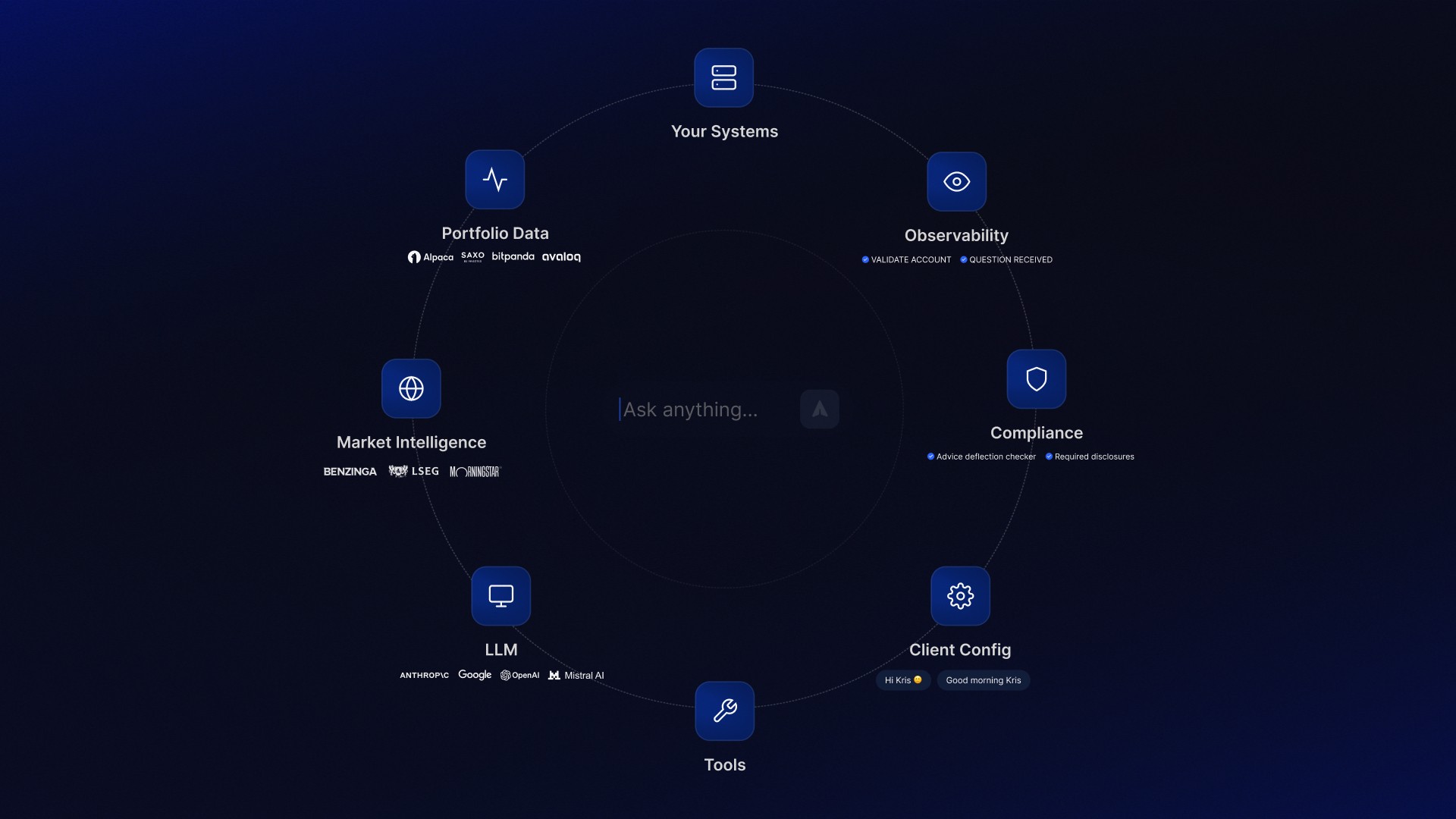
Charlie works as an eight-layer investing AI stack: Your Systems, Portfolio Data, Market Intelligence, LLM, Tools, Client Config, Compliance, and Observability. The assistant in the middle is what the user sees. The stack around it is what makes the experience useful inside a regulated investing product.
The stack in one view
The eight layers are the practical building blocks around Charlie.
Layer | What it means in Charlie | Why it matters |
|---|---|---|
Your Systems | Core banking, CRM, PMS, internal APIs, and institution-specific workflows. | Charlie should fit into the environment already running, not force the institution to replace its stack. |
Portfolio Data | Holdings, positions, transactions, performance, account context, and portfolio-level history. | The assistant can only answer personal investing questions well when it is grounded in the user's actual portfolio. |
Market Intelligence | Market news, price context, research, data feeds, instrument context, and approved provider content. | It connects portfolio movements to what is happening in the market, instead of searching online. |
LLM | The model layer that understands questions, reasons over context, and turns tool outputs into clear answers. | The model is powerful, but it should not be the only thing carrying the product. |
Tools | Deterministic calculations, portfolio tools, market tools, execution tools, and workflow tools. | Tools do the work that must be correct, repeatable, and reviewable. |
Client Config | Brand, tone, language, topic scope, greeting style, answer length, enabled tools, and product-specific behaviour. | Charlie needs to feel native to each financial institution, audience, product, and journey. |
Compliance | Advice deflection, guardrails, required disclosures, policy boundaries, and reviewable order flows. | Controls need to shape the interaction itself, not only appear after the answer. |
Observability | Traces, logs, evaluations, review workflows, dashboards, and API-ready outcomes where needed. | Teams need to inspect what happened, improve quality, and operate the product after launch. |
Your Systems
This is the institution's own environment: core systems, CRM, PMS, internal APIs, and workflows that already exist. Charlie is designed to connect into that reality.
This is also why deployment can happen in phases. A pilot does not need every system connected on day one. It needs the right systems for the first use case, then a clear path to expand. That rollout path is covered in Deployment options.
Portfolio Data
Portfolio data is the user's investing context: holdings, positions, transactions, performance, account information, and portfolio history. Without it, an assistant can explain investing in general. With it, Charlie can answer questions about this portfolio, this position, this exposure, and this performance period.
Market Intelligence
Market intelligence gives Charlie context beyond the portfolio: news, price movement explanations, research, instrument data, and approved market-data sources. It is what lets Charlie move from “your portfolio is down” to “these holdings moved, and this is the market context behind it.”
This layer should work with providers the institution already trusts where possible. It keeps the assistant useful without turning the model into a source of market truth.
LLM
The LLM is the reasoning and language layer. It understands the question, keeps the conversation coherent, chooses when the stack needs tools or data, and explains the result in a way the user can understand.
It is still only one layer. Financial institutions may prefer Anthropic, Google, OpenAI, Mistral AI, a private deployment, or another model setup depending on compliance, performance, cost, and infrastructure requirements. The model-choice logic is covered in Choose an LLM that fits your requirements.
Tools
Tools are where the work happens. Charlie should not ask the model to invent portfolio values, P&L, exposure, dividend income, concentration, or order-flow state. Those outputs should come from deterministic tools and controlled workflows.
This is the core idea behind The tools do the real work: the model explains, but tools calculate, check, retrieve, and act.
Client Config
Client Config is the white-label layer. It controls brand behaviour, tone of voice, greeting style, answer length, supported languages, topic scope, enabled tools, product boundaries, and the level of formality in the experience.
That matters because Charlie should not sound or behave the same everywhere. A self-directed investing flow, an advisor workflow, and a private wealth experience may need different tone, scope, and output style. The deeper configuration story is covered in Brand and tone.
Compliance
Compliance is the layer that keeps the assistant inside the institution's policy boundaries. It includes advice deflection, required disclosures, guardrails, escalation behaviour, and reviewable order or conversation flows.
The important point is that compliance is not just a disclaimer at the end. It affects what Charlie can answer, how it should answer, when it should ask a follow-up question, and when it should refuse or redirect. The traceability and guardrail setup is covered in Guardrails and full traceability.
Observability
Observability is how teams inspect and improve Charlie after it is live. It includes traces, logs, evaluations, review workflows, dashboards, and API-ready outcomes where an institution wants to connect results into its own tooling.
This layer is often invisible to the end user, but it is one of the layers that separates a demo from a production product. It lets product, compliance, engineering, and support teams see what happened and keep improving the system.
FAQ
What are the eight layers behind Charlie?
Why is the LLM only one layer?
Which layers make answers accurate?
Can the stack be implemented in phases?
Which layers are hardest to build from scratch?
How should teams use the stack in planning?

Meet Charlie. The Investing AI Agent.
Give your clients an entire investing experience, rebuilt from the ground up as a conversational AI agent.