

A practical starting point for financial institutions
An AI investing agent connects a conversational interface to the data, financial tools and workflows of an investment service. For a bank or wealth manager, the buying decision is about which client journeys the agent can improve, what it may do and how the institution can control its behaviour.
This guide helps product, technology and business teams define a use case, compare implementation approaches and evaluate a provider. Start with one measurable client problem, then assess the data, permissions and operating processes needed to solve it.
What is an AI investing agent?
An AI investing agent uses a language model to interpret a question and coordinate approved tools. Those tools can retrieve portfolio data, find an instrument, calculate a financial result or prepare a step in an investing workflow. The institution determines the product universe, data sources, allowed actions and confirmation requirements.
The language model helps with understanding and explanation. Financial calculations, account information and order handling should come from the relevant systems and validated tools. An agent also needs a defined way to handle missing data, uncertainty and requests outside its mandate.

Portfolio explanations grounded in the client’s own investing context.
Which investing journeys should a bank start with?
Portfolio understanding. Explain performance, composition or concentration using the client’s actual holdings and approved analytics.
Investment discovery. Help clients find relevant instruments through natural-language search within the institution’s available product universe.
Guided execution. Help a self-directed investor prepare an order, understand the inputs and confirm the instruction through an approved workflow.
Contextual education. Explain fees, diversification, risk or order types at the moment a client needs that information.
Investment support. Answer data-backed questions and hand over to a person when the request requires human judgment or assistance.
Advice journeys. Support a separately defined advice proposition with its own suitability process, permissions, disclosures and approvals.
Choose the first journey by its business value and implementation readiness. A recurring question with reliable underlying data is usually easier to evaluate than an open-ended assistant expected to handle every investing task.
How do a chatbot, a copilot and an investing agent differ?
These labels describe overlapping approaches, so ask providers to demonstrate the actual workflow. A chatbot may explain published information. A copilot may help a client or employee complete a task. An investing agent may coordinate data retrieval, financial tools and a multi-step process. The useful distinction is what the system can access and do, and how those permissions are enforced.
For a portfolio question, request a demonstration using known holdings and check the underlying figures. For an order journey, check how the system selects the correct account, validates the inputs, requests confirmation and handles an interrupted or failed action.
What makes an investing agent different?
Evaluate
General chatbot
AI investing agent
Data
Published content and general information.
Portfolio context and institution-approved data.
Calculations
Generates an explanation.
Calls validated financial tools.
Actions
Answers within a chat interface.
Coordinates approved workflows and confirmations.
Controls
Prompt instructions and generic content policies.
Mandates, permissions, evaluations and traceability.
Ask providers to demonstrate the complete workflow using your institution’s data, permissions and confirmation requirements.
Should a bank build or buy its AI investing agent?
Build in-house
An internal build can give a team direct control over the experience and architecture. The institution must also own integrations, tool permissions, evaluations, monitoring, support and the ongoing work required when models or workflows change. Assess the full operating responsibility alongside the initial prototype.
Adopt an agent platform
A platform can provide existing agent configurations, financial tools and integration patterns. Evaluate which capabilities are available for your specific use case, what must be configured or developed, and which responsibilities remain with the institution. Ask to see evidence using your intended workflow.
Use a hybrid approach
A bank can retain its app, product proposition and selected services while adopting an agent platform for orchestration and investing journeys. Compare ownership of the user experience, integration effort, model flexibility, data access and the ability to change providers or extend the solution.
How does an AI investing agent integrate with an existing app?
Begin with the systems the agent needs to use: client identity, portfolios, transactions, market data, product information and the relevant investing workflows. Define which system is authoritative for each piece of information and which operations are read-only or require a client instruction.
The delivery model can range from a hosted experience to an embedded web module, native interface elements or a headless API integration. The appropriate choice depends on the app architecture, desired control over the interface and the institution’s delivery capacity.
Request an integration plan that names the required interfaces, authentication model, data freshness rules, failure handling and responsibilities. Include how the agent behaves when a service is unavailable or a portfolio record is incomplete.
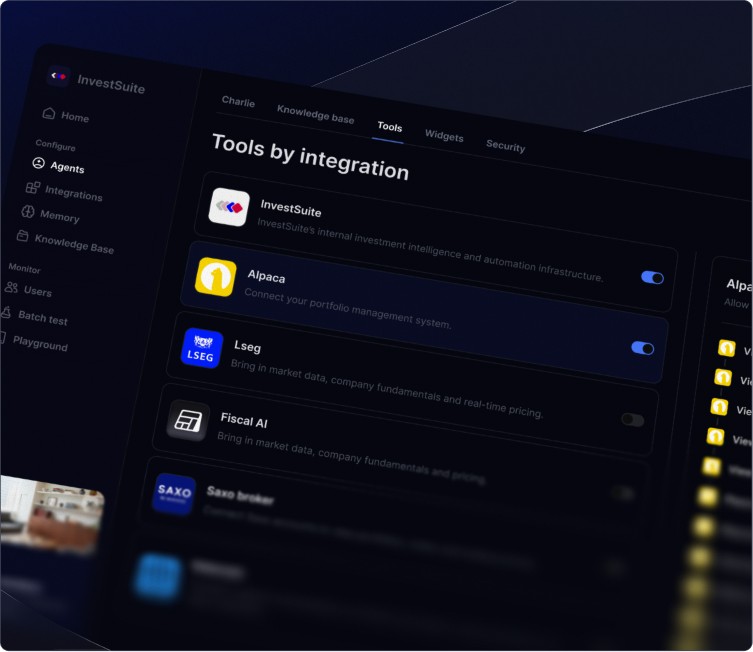
Illustrative Charlie tools dashboard. Connected services depend on the institution’s integration scope.
What should financial institutions evaluate in a provider?
Mandate and permissions. Which data and tools can each agent use? How are self-directed and advice journeys configured separately?
Financial accuracy. Which results come from validated calculations and source systems? Can an answer be traced to those results?
Action controls. Which steps can the agent prepare, which require confirmation and what happens when an action fails?
Security and data handling. How are identity, access, retention, hosting and model-provider arrangements handled for the proposed implementation?
Evaluation and monitoring. How is the agent tested before release and after changes to models, prompts, tools or workflows?
Integration and experience. Can the platform fit the existing app and connect to the required financial services?
Operating model and cost. What is included in the licence, implementation and support? Who owns incident handling and ongoing improvement?
Use the same requirements and test scenarios for every provider. Request a demonstration, supporting documentation and a scoped implementation proposal. A useful comparison shows both the capability and the evidence needed to verify it.
Read the eight-layer architecture behind trusted investing AI.
How should a bank choose the underlying LLM?
Evaluate the model within the complete investing workflow. Relevant criteria include instruction following, tool use, latency, language coverage, cost and the institution’s data requirements. A strong answer in a general benchmark does not establish that an agent will correctly follow a particular order or advice workflow.
Test representative questions, ambiguous requests, unavailable data and attempted actions outside the mandate. Compare the results using the same approved tools and evaluation set. Separate the model’s ability to explain a result from the financial engine’s responsibility to calculate it.
Get the Charlie solutions brief
Explore the use cases, integration options and controls behind Charlie. See how questions become portfolio insights and guided investing journeys.

How can a bank measure the ROI of an AI investing agent?
Define a baseline and a limited pilot before making a broad rollout decision. Select a client segment, a specific journey and measurable success criteria. Where practical, compare the experience with a suitable control group so changes in behaviour can be assessed against other influences.
Activation and engagement. Measure funded-account activation, repeat usage and successful completion of the selected client journey.
Discovery and execution. Track zero-result searches, order-flow starts, completion rates and the time needed to complete a task.
Service outcomes. Measure resolution rates, support handovers and the quality of answers alongside any reduction in support contacts.
Reliability and experience. Track financial-data errors, out-of-mandate behaviour, failed tool calls and response latency.
Economics. Compare measurable benefits with licensing, integration, model usage, monitoring and support costs.
Commercial outcomes such as higher engagement, investment activity or lower service costs are hypotheses to test. Agree on the measurement method, reporting responsibilities and conditions for expanding the pilot before launch.
Where does Charlie fit?
Charlie is InvestSuite’s AI investing agent platform for financial institutions. It combines language models with institution-controlled data, financial tools, workflows and configurable agent mandates. It can support portfolio explanations, investment discovery, contextual education and guided investing journeys.
Charlie can also support a separately configured advice proposition. The institution defines the mandate, product universe, suitability process, approvals and operating responsibilities. The integration and available tools should be scoped against the specific experience the institution wants to deliver.
A useful Charlie demonstration starts with one real institutional requirement: the client question, the underlying data, the permitted tools and the intended next step. That gives the team a concrete basis for evaluating experience, integration and controls.
Explore Charlie and see the investing experience.
Read the Charlie solutions brief.
A practical next step
Write a short brief for the first use case. Include the client problem, target segment, current baseline, source systems, allowed actions and pilot success criteria. Use that brief to compare an internal build with a platform implementation and to request demonstrations against the same requirements.

Bring portfolio answers, investment discovery and guided order journeys into your bank’s own app.
Frequently asked questions
What is an AI investing agent for a bank?
Can an AI investing agent use a client’s actual portfolio?
Can a bank add an agent to its existing investing app?
Can an AI investing agent provide personalised advice?
How can institutions reduce the risk of incorrect financial answers?
How should a bank compare providers?
How should a bank evaluate pilot results?
What is Charlie?
Conclusion: Turn questions into investor action
AI investing agents can help banks connect client questions with portfolio insights, investment discovery and guided journeys inside their own app. A strong implementation starts with a clear client problem and the data, tools and controls needed to solve it.
Focus the first rollout on:
One valuable client journey. Choose a recurring need, such as understanding a portfolio or finding an investment.
Institution-controlled execution. Define source systems, permissions, validated tools and client confirmations.
Measurable pilot results. Test experience, reliability and economics against an agreed baseline before expanding.
Charlie brings these building blocks together in an AI investing agent platform for financial institutions. Start with a scoped use case and evaluate the complete journey, from the first question to the approved next step.